
A Plan B for Nigerian families — residence in a Schengen country, not another visa application.
In 2025, nearly one in two Schengen visa decisions on applications lodged in Nigeria ended without a visa — and of the visas that were issued, fewer than three in ten allowed more than one entry.
A residence permit issued by a Schengen state ends that cycle. Short stays are made on the permit, up to 90 days in any 180, instead of on a fresh application for each trip — and the permit carries the right to reside in the country that issued it, on that programme’s terms.
We advise on the available investment-based routes, calculate the full cost before you proceed and coordinate the qualifying investment, legal work and residence application from start to finish.
For families already operating across borders.
Life in Nigeria stays exactly as it is. A European residence sits alongside it, not in place of it.
Your business may trade or bank across several countries. Your children may study abroad. You may already own property outside Nigeria, hold a domiciliary account, have family in Europe or the United Kingdom, and travel several times a year.
For families in that position, the visa cycle is not an obstacle to any one journey. It is a recurring administrative cost: evidenced again, decided again, and paid again, several times a year.
Investment-based residence gives the family a long-term legal position outside Nigeria without requiring you to relocate or to change where you are tax resident. The objective is straightforward: greater mobility, and another jurisdiction available to the family if it is ever needed.
47.9%
of the 110,956 Schengen short-stay decisions recorded on applications lodged in Nigeria in 2025 did not result in a visa — 53,196 of them, from 113,359 applications lodged. European Commission consulate statistics, published 28 May 2026.
29.3%
of the visas that were issued permitted more than one entry, against 51.7% Schengen-wide. The cost is not one refusal; it is the application that comes round again.
142,000
Nigerian students were studying abroad in 2023, level with Germany on 5% of all internationally mobile students and behind only China and India. UNESCO.
What a residence permit issued by a Schengen state changes.
A Nigerian passport requires a visa for short visits to the Schengen Area, and each visa is a decision taken about your family again.
A valid residence permit issued by a Schengen state changes that. The holder can generally make short stays elsewhere in the Schengen Area for up to 90 days in any 180-day period without obtaining a separate short-stay visa, subject to the ordinary border-entry conditions.
You also hold the right to reside in the country that issued the permit, subject to that programme’s conditions.
The passport remains Nigerian. What changes is that the journey stops being an application.
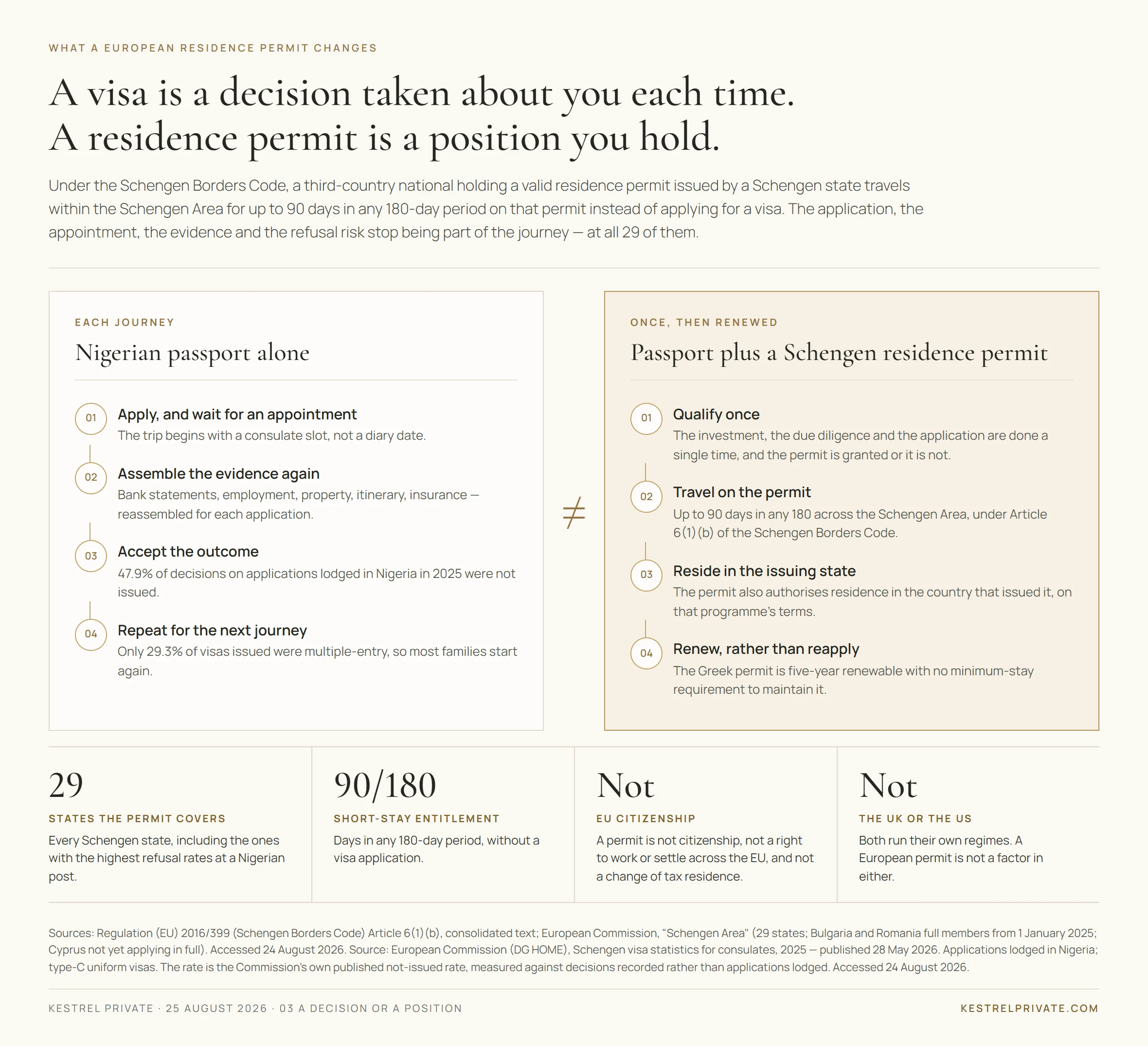
Plan A stays. Plan B sits quietly alongside it.
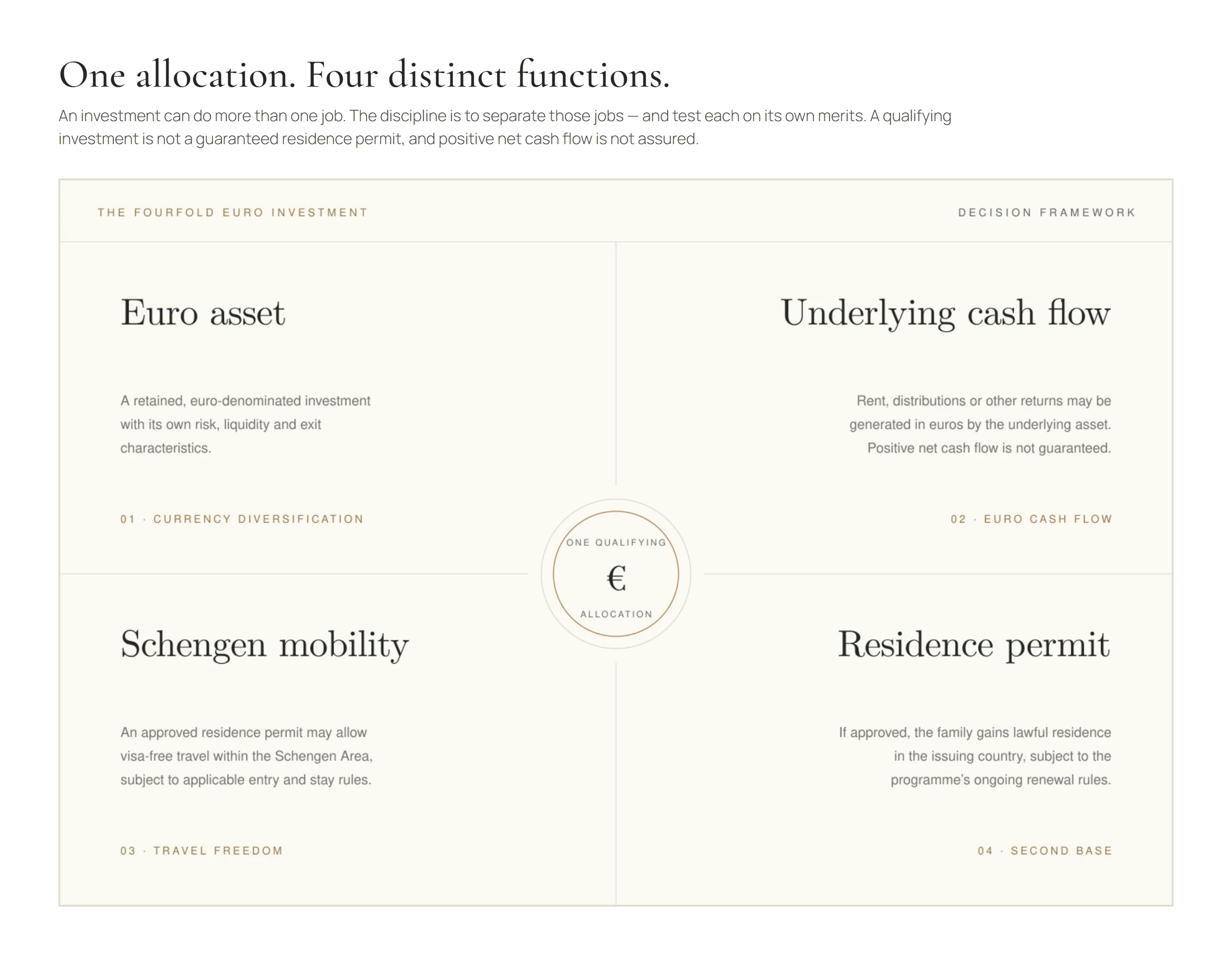
For most of the families we act for this is not an emigration decision. The business, the home and the life stay in Nigeria. It is an allocation decision: many already hold part of the family’s capital outside the country, and the question we are asked is whether a defined part of that allocation can also secure something a portfolio on its own cannot — a lawful right for the family to live in Europe.
The same allocation is asked to do four things at once: hold value in euro rather than in naira, produce potential income or growth in euro, support a European residence position for the family, and — where the programme provides it — widen how freely they travel. One allocation, four functions; but four separate tests, each met on its own merits.
For this problem, Greece is usually where we start.
If your objective is the one this page describes — an application repeated for every journey — Greece is normally the first route we examine. A qualifying investment supports an application for a five-year renewable Greek residence permit, and because Greece is a Schengen state, short stays across the Area are then made on the permit rather than on a fresh application each time.
That is the common case, not the only one. There is no single “best” programme, and where the objective is different, so is the route:
- European mobility: Greece
- A permanent European base: Cyprus
- A second citizenship: Grenada or São Tomé & Príncipe
We normally decide the objective first and then compare the routes that can achieve it, including the total cost, family eligibility, investment, time required and material limitations. Every route is subject to government due diligence and approval; none of them is granted by making an investment.
Greece
A five-year renewable Greek residence permit through qualifying property, subject to government due diligence and approval, with no minimum-stay requirement to maintain it. Short-stay travel across the Schengen Area is then made on the permit, up to 90 days in any 180, rather than on a fresh application for each journey.
- Qualifying property → renewable Greek residence
- Short-stay Schengen travel on the permit
- A euro-denominated asset held outside Nigeria
- No minimum stay to maintain the permit
€280,000
Cyprus
Permanent residence in Cyprus for the main applicant, spouse and eligible dependants, subject to the programme’s dependency rules, its income test and government approval — an EU jurisdiction with a familiar common-law tradition and English widely used in business and professional life. Cyprus is an EU member but not in the Schengen Area. Accession is EU-backed and expected, but it needs a unanimous Council vote, has no confirmed date and cannot be guaranteed. Its case is a permanent base in Cyprus, not Schengen travel.
- Property → permanent residence
- Spouse and minor children included; adult children on stricter terms
- Secure annual income of at least €50,000 required
- Common law, in English
Citizenship and residence solve different problems.
Nigerian applicants are the largest single nationality applying to Grenada — 15% of applications to the end of the third quarter of 2025, on the Grenadian agency’s own quarterly figures. It is a real route with a real job — additional travel access, held permanently, passed to a spouse and children — and it carries two live conditions that are set out in full below rather than at the end of a process.
São Tomé & Príncipe provides a substantially lower-cost route to a second citizenship, but its passport should not be considered an upgrade to a Nigerian passport for travel.
For many families the appropriate structure is therefore European residence for mobility and a separate citizenship for the long term. They do not need to be acquired at the same time.
Grenada
Citizenship through a government contribution, subject to due diligence, interview and approval. It reaches the United Kingdom on an electronic travel authorisation and China for short stays. Two live conditions are set out below: its Schengen waiver is under EU challenge, and a presence obligation has passed into law without yet commencing.
- Contribution → citizenship
- United Kingdom on an ETA
- Presence rule passed, not in force
USD 255,000
São Tomé & Príncipe
A statute-based citizenship at the lowest current entry cost of the routes on this page, held by most families alongside a European residence rather than in place of one. The programme itself is denominated in dollars — the figure shown is our all-in planning estimate in euro. Its own passport does not open Schengen, the United Kingdom, the United States or China, and it is not a travel upgrade.
- Contribution → citizenship
- Statute-based · Decreto-Lei 07/2025
- Held alongside an EU residence
€100,000
How we calculate the all-in figures
All-in figures are indicative for a single applicant — the qualifying property or contribution plus all taxes, duties, legal, government and due-diligence fees and the Kestrel engagement fee (€10,000, or US$10,000 where the programme is dollar-denominated, VAT included; a second application instructed alongside the first is reduced by 20%) — confirmed precisely on engagement. Greece is the €250,000 change-of-use entry tier (Law 5100/2024 art. 64), costed all-in — the tier on which we transact; standard qualifying property is €400,000. On that tier the change of use must be completed before the application is filed, which the law evidences by an engineer’s certificate on the planning act rather than by the building being finished or connected to services, and the category may be used only once per property. Cyprus is the €300,000-plus-VAT qualifying new-build purchase modelled complete at the 19% VAT rate. Grenada is the National Transformation Fund donation (USD 235,000) plus government, due-diligence and processing fees. São Tomé & Príncipe is the complete citizenship stage built on the USD 90,000 single-applicant contribution — about €78,000 — (USD 95,000, about €83,000, for a family of up to four) plus application, due-diligence and professional fees. A qualifying investment does not guarantee approval. Figures verified against the programme dossiers, 2026.
What changed in 2026, at both ends.
For many Nigerian families the practical obstacles to holding European residence have been administrative, and they applied at both ends of the transaction.
On 29 January 2026, Nigeria was removed from the European Union’s list of high-risk third countries by Commission Delegated Regulation (EU) 2026/83, following the Financial Action Task Force’s own removal on 24 October 2025. The mandatory, country-based enhanced due diligence that European banks, lawyers and notaries had to apply to Nigerian-linked business since February 2023 no longer applies.
On 1 June 2026, the Central Bank of Nigeria’s fourth-edition Foreign Exchange Manual removed the Form A requirement for self-funded outward remittances from an ordinary domiciliary account, and set direct telegraphic transfers from such accounts at up to USD 10,000 a day.
Neither change creates an entitlement to residence, relaxes government due diligence or makes an application more likely to be approved. What they change is the mechanics of documenting a legitimate Nigerian file and moving lawfully held capital through the banking system.
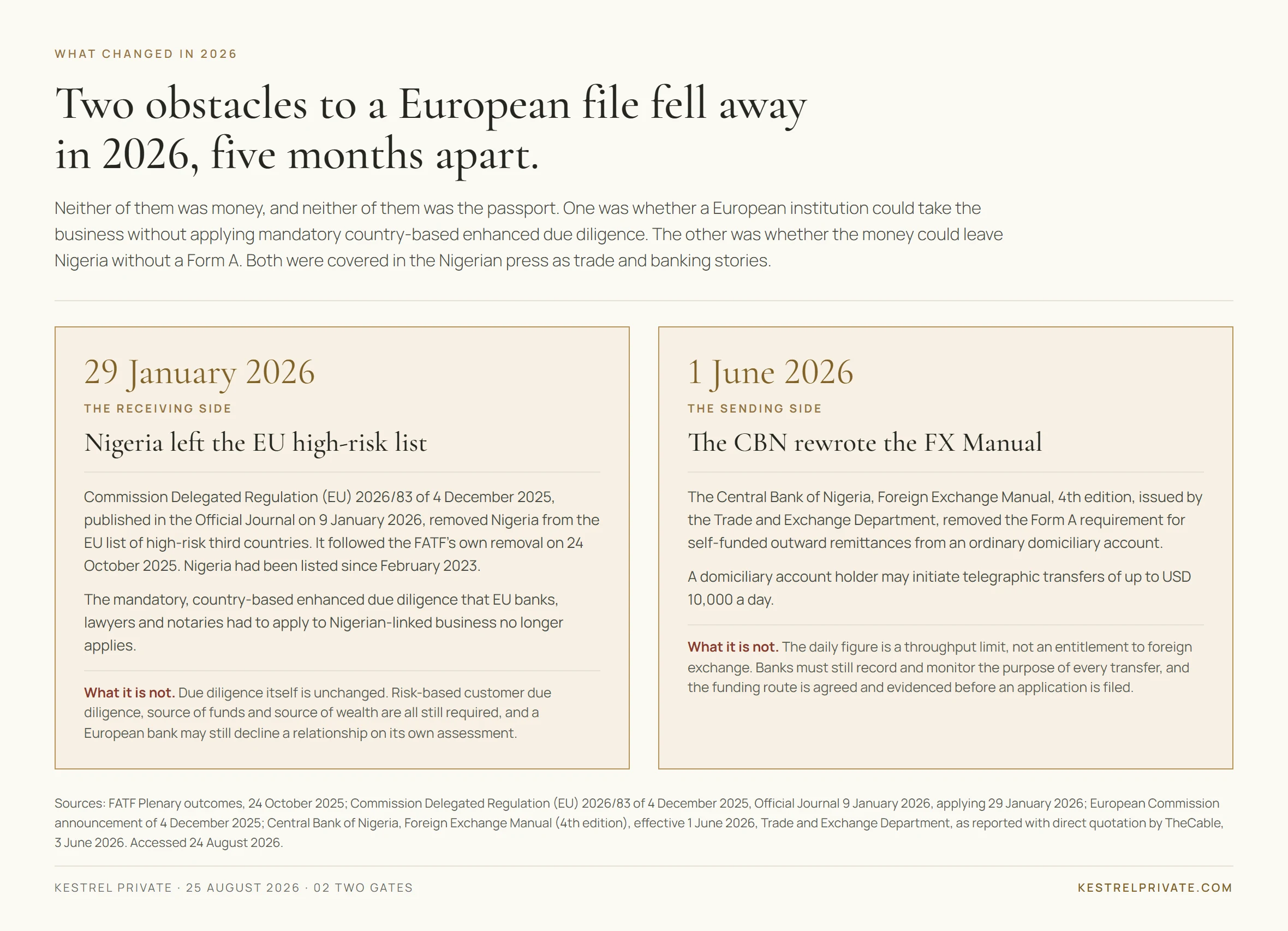
How a purchase is funded, and what it does not change.
Moving the capital
Most families we act for fund a qualifying purchase from money already held outside Nigeria. Where that is the position, Nigerian exchange control is not on the critical path at all — the funding question is one of evidence, not of permission.
Where capital does have to move from Nigeria, the position eased on 1 June 2026: a self-funded outward remittance from an ordinary domiciliary account no longer requires a Form A, and the account holder may initiate telegraphic transfers of up to USD 10,000 a day. Against a €280,000 Greek file — about USD 322,000 at €1 = US$1.15 — that is roughly thirty-three days of transfers at the ceiling.
In practice, most families we act for fund a qualifying purchase from money already held outside Nigeria, or move it over a period. The daily figure is a throughput limit, not an entitlement to foreign exchange, and the funding route is agreed and evidenced before an application is filed — not afterwards.
Tax, and what a permit does not do
A European residence permit does not change where you are tax resident. Nigeria taxes residents on worldwide income; that was the position before the Nigeria Tax Act 2025 and it is unchanged by it.
Under the Nigeria Tax Act 2025, in force from 1 January 2026, an individual who remains resident in Nigeria is generally taxable there on income and gains wherever they arise.
Tax residence changes only if the underlying facts change. Where a family is considering that, it is a separate advisory exercise taken with Nigerian and destination-country counsel, and it is not what a residence permit does on its own.
The limits, before the decision rather than after it.
- A residence permit is not citizenship. It authorises residence in the issuing country and short-stay travel within Schengen — not an unrestricted right to work or settle across the European Union, and not a change of tax residence.
- Grenada’s Schengen access is under EU challenge and should be treated as at material risk across the 2026–2028 window; its United Kingdom and China access is unaffected by that process.
- Grenada has legislated a presence obligation that has not commenced. Thirty days in aggregate across the first five years after the grant, with each named dependant present at least five days in the first twelve months; its commencement was deferred on 21 August 2026 and it may be applied to files pending when it does begin.
- Cyprus is a base, not a Schengen route. Cyprus is an EU member but not in the Schengen Area. Accession is EU-backed and expected, but it needs a unanimous Council vote, has no confirmed date and cannot be guaranteed.
- A second passport is not automatically a stronger one. São Tomé & Príncipe does not open Schengen, the United Kingdom, the United States or China; it is worth holding as a citizenship, not as a travel document.
- Nothing here improves a United Kingdom or United States application. Both run their own regimes, and a European residence permit is not a factor in either.
Full programme conditions and sources
Under Regulation (EU) 2025/2441, operating an investor-citizenship programme is itself a ground for suspending a visa exemption. The European Commission is reported to have written to the five Caribbean programmes on 25 June 2026 seeking a phase-out by 1 June 2028; we have not seen the letters themselves, and no suspension has been enacted. A family acquiring Caribbean citizenship primarily for Schengen access should treat that benefit as at material risk across the 2026–2028 window.
Grenada’s presence obligation sits in new sections 7A and 7B of its citizenship legislation and was deferred by IMA Grenada Circular No. 2 of 2026 on 21 August 2026; section 7B(6) allows it to reach applications pending when it does commence, so a file is planned on the thirty-day basis rather than on the assumption that it will not apply. Grenada’s implied rejection rate in 2025 was about 14%, against a historical average of about 8%: a qualifying contribution is an application, not a purchase. The full conditions, dates and sources are set out on the Grenada programme page.
Dual citizenship, and the part that is commonly missed.
A Nigerian citizen by birth who acquires another citizenship keeps Nigerian citizenship. The forfeiture rule in section 28(1) of the 1999 Constitution applies only to a person who is not a Nigerian citizen by birth.
A Nigerian who is not a citizen by birth is in a different position. Under section 28(1) such a person forfeits Nigerian citizenship if they acquire or retain the citizenship of another country of which they are also not a citizen by birth. It is a question about the individual’s own citizenship history, not about a category, so it is checked against the documents rather than assumed.
So in a family where one spouse is Nigerian by birth and the other acquired Nigerian citizenship later, a second citizenship may not be the same decision for both of them. That is tested against the family’s own documents before a route is recommended, not afterwards.
It is one reason a European residence permit and a second citizenship are considered separately rather than as versions of the same thing. A residence permit raises no question of Nigerian citizenship at all.
Residence planning as part of a wider family strategy.
UNESCO’s Higher Education Global Trends Report places Nigeria level with Germany on 5% of all internationally mobile students in 2023, behind only China (37%) and India (29%). It records about 142,000 Nigerian students abroad that year across 21 major destinations, up from 71,753 in 2020.
The foreign-exchange rules treat those years differently. Official foreign exchange is available for university tuition up to USD 25,000 a semester, paid directly to the institution, with a maintenance allowance of USD 5,000 a quarter for students living off campus — and it is not available at all for nursery, primary, secondary or A-level fees. Families with children at school abroad usually hold funds outside Nigeria for that reason alone.
Depending on the programme, spouses and children may be included in the same application, and residence may give the family a base in Europe while children are studying abroad.
Eligibility ages, education rights, employment rights and university fee treatment differ materially between programmes, so these are assessed against the family’s circumstances before a jurisdiction is recommended.
Nigeria, answered.
- Why are so many Schengen visa applications lodged in Nigeria not issued?
- The European Commission publishes the outcome, not the reasoning. In 2025, 113,359 short-stay applications were lodged in Nigeria and 110,956 decisions were recorded; of those decisions, 53,196 were not issued — 47.9%, against 14.6% worldwide. The rate is against decisions recorded, not applications lodged. The Commission’s “not issued” category covers both refused applications and those whose examination was discontinued under Article 8(2) of the Visa Code, so it should not be read as a pure refusal rate. The published data is by consulate location rather than by nationality, and individual posts differ widely — on the same 2025 data, not-issued rates on applications lodged in Nigeria ranged from 6.5% at one post to 66.1% at another. A valid residence permit issued by a Schengen state usually removes the need for a separate Schengen visa for short stays, subject to the Schengen Borders Code and the ordinary entry conditions, so the journey is made on the permit rather than on an application.
- What does the multiple-entry figure mean in practice?
- A single-entry visa is spent on one journey. Of the Schengen visas issued on applications lodged in Nigeria in 2025, 29.3% were multiple-entry, against 51.7% across all Schengen consulates worldwide and 73.1% on applications lodged in South Africa. The figure fell from 35.5% in 2024. For a family travelling several times a year for business, school terms or property, that is the difference between one application and several. A residence permit removes the application entirely for short stays within the Schengen Area.
- What did Nigeria’s removal from the EU high-risk list actually change?
- Commission Delegated Regulation (EU) 2026/83 of 4 December 2025, published in the Official Journal on 9 January 2026 and applying from 29 January 2026, removed Nigeria from the EU list of high-risk third countries, following the FATF’s own removal on 24 October 2025. The practical effect is that the mandatory, country-based enhanced due diligence which EU banks, lawyers and notaries had to apply to Nigerian-linked business since February 2023 no longer applies. It is not a relaxation of due diligence. Risk-based customer due diligence, source of funds and source of wealth are all still required in full, and a European bank may still decline a relationship on its own assessment.
- Can the capital for a qualifying purchase lawfully leave Nigeria?
- The Central Bank of Nigeria’s Foreign Exchange Manual, fourth edition, took effect on 1 June 2026. It removed the Form A requirement for self-funded outward remittances from an ordinary domiciliary account and provides that a domiciliary account holder may initiate telegraphic transfers of up to USD 10,000 a day. Banks must still record and monitor the purpose of each transfer. In practice most families we act for fund a qualifying purchase from money already held outside Nigeria, or move it over a period; the daily figure is a throughput limit, not an entitlement to foreign exchange, and the funding plan is agreed before an application is filed.
- Would a European permit help with a United Kingdom or United States visa?
- No. The United Kingdom and the United States run their own regimes, and a European residence permit is not a factor in either. Nothing on this page should be read as improving a United Kingdom or United States application. Where United Kingdom short-stay access is itself the objective, Grenadian citizenship may be the relevant route to examine — subject to government due diligence, interview and approval, passport issuance, the ETA rules, future United Kingdom policy, and the two conditions set out on this page.
- Does a second citizenship affect my Nigerian citizenship?
- It depends how you became Nigerian. A Nigerian citizen by birth who acquires the citizenship of another country retains Nigerian citizenship; section 28 of the 1999 Constitution does not apply to a citizen by birth. A person who became Nigerian by registration under section 26, or by naturalisation under section 27, forfeits Nigerian citizenship on acquiring the citizenship of another country other than by birth. In a family where one spouse is Nigerian by birth and the other became Nigerian by registration, a second citizenship is therefore not the same decision for both of them. A residence permit raises no question of Nigerian citizenship at all.
- Does this mean leaving Nigeria?
- No, and most of our clients do not. A residence permit creates the ability to spend time in another country lawfully; it carries no obligation to use it, and the Greek route has no minimum-stay requirement to maintain it. It also does not change where you are tax resident — Nigeria taxes residents on worldwide income, and that is unchanged by holding a permit abroad.
Find out which route fits your family.
Tell us who needs to be included, what you currently hold and what you want to achieve. We will compare the relevant routes, confirm the full cost, set out how the investment is funded and explain the likely timetable before you make a decision.
If we do not think there is a compelling reason for you to proceed, we will tell you.
Start private assessmentGeneral information only, not legal, tax, immigration or investment advice. Programme rules, processing times, eligible family relationships, visa policies and costs can change. Approval, timing, asset performance and positive net cash flow are not guaranteed. Regulated advice is provided by licensed professionals in the relevant jurisdiction. Kestrel Private manages the private-client engagement and facilitates submission through the required official licensed channels with admitted local professionals. It is not a law firm.
The programme you apply under is the one that exists on the day you file.
For residence applications, we generally plan on approximately two to three months to approval and three to six months from instruction to residence card.
Citizenship applications vary more widely. A straightforward application may receive approval within approximately three months, but six to nine months to passport issuance is a more prudent planning assumption.
Programme rules, government fees and processing times can change. We therefore reconfirm the applicable terms immediately before an application is filed.
Neither approval nor timing can be guaranteed.
If this is the position you want, we can start your file.
A first conversation, not a commitment. Tell us who would be included, what you already hold and what you want the structure to achieve, and we come back with the route, the confirmed terms and the timeline — or tell you if we do not think it is worth proceeding.