
A European Plan B for Americans, without giving up Plan A.
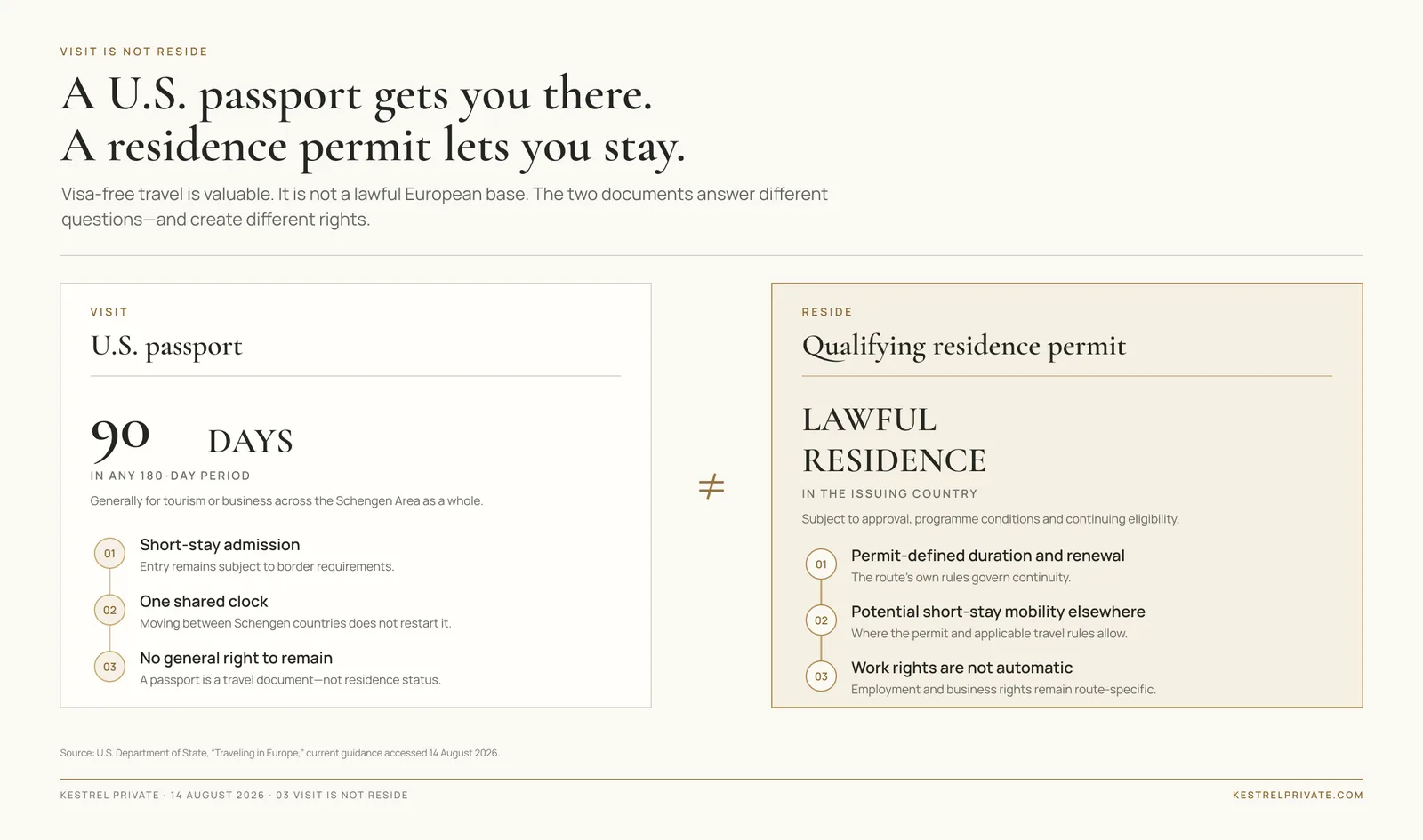
A U.S. passport makes Europe easy to visit. It does not give your family the right to remain.
We compare lawful residence routes, test the qualifying investment on its own merits, and coordinate the U.S. tax, ownership and application detail the generic programme sites leave out.
The first decision can be smaller than relocation.
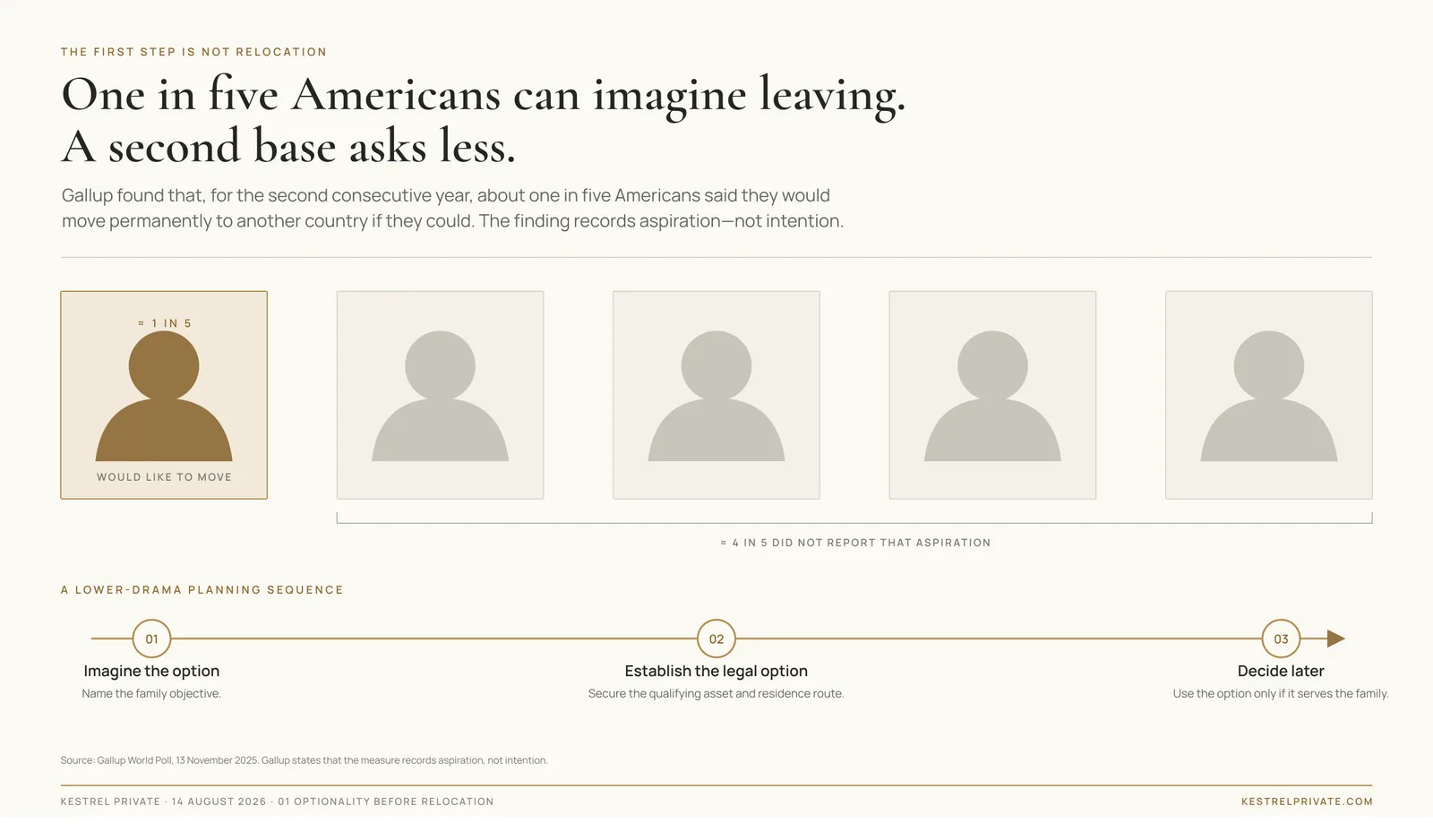
Gallup found that, for the second consecutive year, about one in five Americans said they would move permanently to another country if they could — and expressly cautions that this records aspiration, not intention. The measured first step is to define the objective, establish a lawful option, and decide later whether to use it.
A powerful passport lets you visit Europe. It does not let you live there.
With a valid U.S. passport, tourism and business travel across the Schengen Area is generally limited to 90 days in any 180. A qualifying residence permit is different: it can authorise lawful residence in the issuing country and, where applicable, short-stay mobility elsewhere in Schengen. It is not EU citizenship and it does not automatically confer a right to work or settle in every EU state.
The country can change direction. Your family plan should not reset every two years.
In 2026, Pew found almost identical majorities held unfavourable views of the Republican and Democratic parties. That is not a reason to leave America. It is a reason not to make the family’s long-term optionality depend on one party, one election or one political forecast. A second base is a measured addition, established while the decision can still be made calmly.

Choose the legal position before the destination.
Each route creates a different legal position — duration, renewal, presence, family coverage. We test the position first, then the asset that secures it, with admitted local counsel and U.S. tax advisers coordinated from the start.
Greece
Five-year renewable residence through qualifying property, with no minimum stay to maintain it. For an American, the added value is not basic visa-free travel; it is lawful residence in Greece, family coverage and the ability to spend time there beyond the ordinary visitor limit.
- Property → renewable residence
- Family coverage
- No minimum stay
€250,000 / €400,000 / €800,000, depending on the property and route, plus all costs.
Cyprus
Permanent residence through qualifying new-build first-sale property in an English-speaking, common-law EU jurisdiction, maintained with a visit at least once every two years. Cyprus is not yet fully in Schengen; its case is permanent residence in Cyprus, not Schengen access.
- Property → permanent residence
- English-speaking, common law
- One visit every two years
€300,000 + VAT, plus all costs.
Portugal
A residence-by-investment route through a qualifying €500,000 regulated fund subscription, with low physical-presence requirements and material current processing delays. For a U.S. person, the fund cannot be treated as suitable until PFIC and wider U.S. tax consequences have been reviewed in writing.
- Fund → residence route
- Low physical presence
- PFIC review before commitment
€500,000 fund subscription, plus all costs.
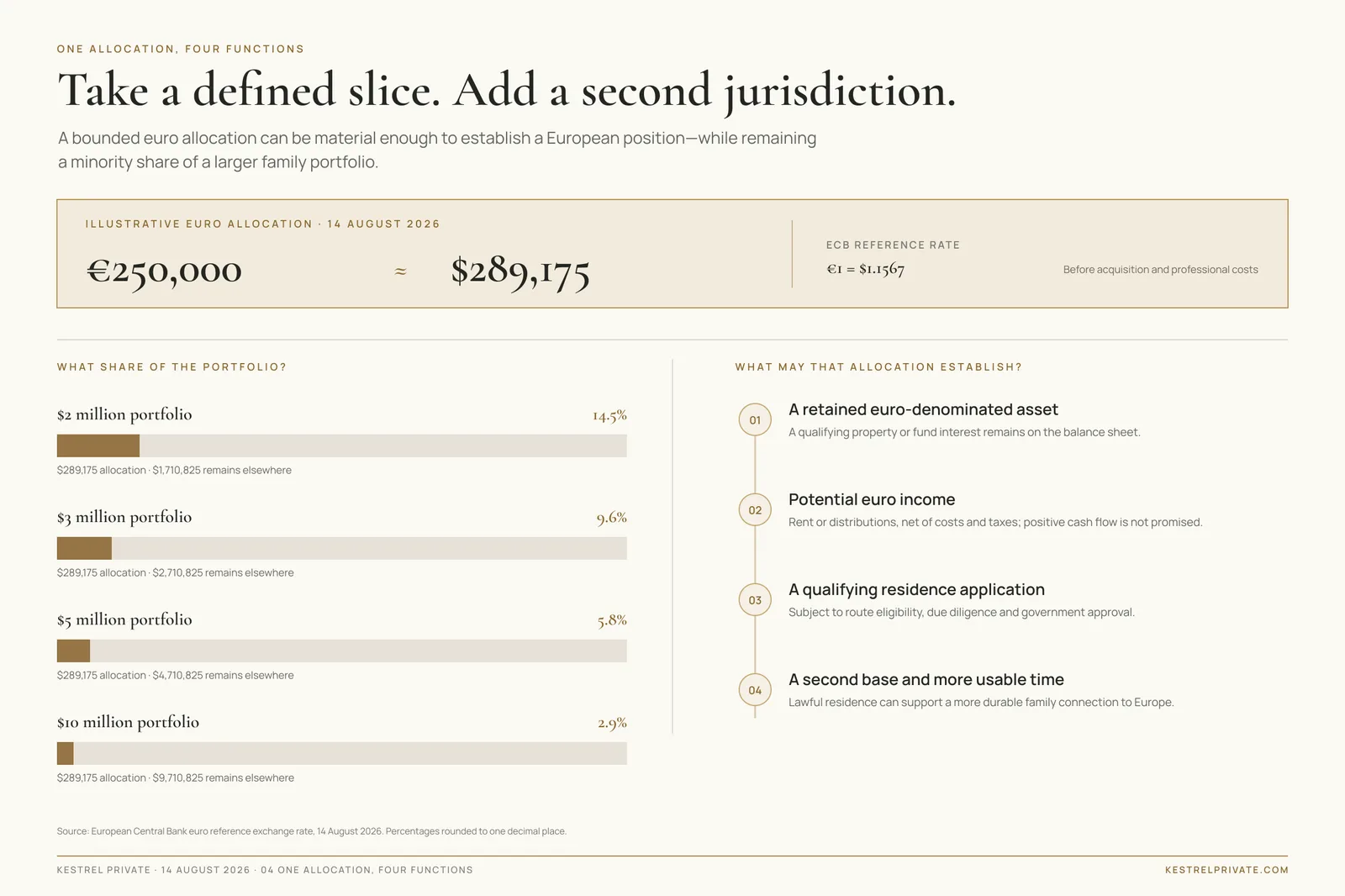
Figures are the programmes’ qualifying thresholds, before taxes, VAT, legal, government, due-diligence and Kestrel fees — confirmed precisely on engagement. At the ECB reference rate of 14 August 2026 (€1 = $1.1567), €250,000 equalled approximately $289,175 before costs. A qualifying investment does not guarantee approval or positive cash flow.
Take a defined slice. Add a second jurisdiction.
A bounded euro allocation can be material enough to establish a European position while remaining a minority share of a larger family portfolio. The percentage is context, not a recommendation — the investment must work even before the residence benefit is counted.
The American detail, handled before the capital moves.
Worldwide tax still applies
A second residence or passport does not end U.S. tax. U.S. citizens and resident aliens are generally taxed on worldwide income wherever they live. Foreign tax credits and treaty positions may reduce double taxation, but the analysis starts before the asset is acquired — not after the first return is due.
The ownership vehicle matters
Foreign accounts, funds, companies and trusts can create additional U.S. filings and, in some cases, unfavourable tax treatment. We put U.S. counsel around the proposed ownership before commitment — including possible FBAR, Form 8938, PFIC, foreign-company and foreign-trust consequences. No foreign fund should be presented to a U.S. person as a simple substitute for a domestic fund.
The United States does not require you to choose one nationality.
U.S. law does not require an American citizen to choose between U.S. nationality and another nationality. A dual national remains subject to the laws and obligations of both countries and must use a U.S. passport to enter and leave the United States. Whether the other country permits dual nationality must be tested separately.
Read the State Department positionMake Europe part of the family’s life, not merely its contingency plan.
Where programme rules allow dependants to be included, a European residence can give children a place to spend meaningful time, build familiarity and make later education or relocation decisions from experience rather than theory. Dependant ages, schooling access, work rights and university fee status vary and are confirmed for the specific family before any claim is made.
America, answered.
- Does the United States allow dual citizenship?
- Yes. U.S. law does not require a citizen to choose between U.S. nationality and another nationality. The other country’s law must also permit it, and obligations in both countries remain.
- Will European residence reduce my U.S. tax?
- Not by itself. U.S. citizens and resident aliens are generally taxed on worldwide income. Local tax residence, treaty relief, foreign tax credits and the ownership of the asset all require separate analysis.
- How long can an American stay in the Schengen Area without residence?
- Generally up to 90 days in any 180-day period for tourism or business across the Schengen Area as a whole. A residence permit can authorise residence in the issuing country beyond that visitor limit, subject to its terms.
- Does a Greek or Portuguese permit let me live anywhere in the EU?
- No. It authorises residence in the issuing country. It may also support short-stay travel elsewhere in Schengen, but it is not EU citizenship and does not confer an unrestricted right to settle or work in every member state.
- Can my spouse and children be included?
- Often, yes, but the eligible relationships, dependant ages and evidence differ by programme. The family composition should be tested before choosing the jurisdiction.
- Can I use a retirement account, trust or company to make the investment?
- Do not assume so. Programme rules and U.S. tax rules both matter. The funding source and ownership vehicle should be cleared in writing before any transfer or subscription.
Build the option while the decision is still yours.
We will establish who needs to be included, how much time you want in Europe, what capital can properly be used and which legal position fits — then tell you honestly whether it is worth doing.
General information only, not legal, tax, immigration or investment advice. Programme rules, processing times, eligible family relationships and costs can change. Approval, timing, asset performance and positive net cash flow are not guaranteed. Regulated advice is provided by licensed professionals in the relevant jurisdiction.