
A Plan B for Kenyan families — a status you hold, not a permission you request.
For Kenyan families with business, education, property or family interests abroad, European residence can remove the need for repeated Schengen visa applications and establish a long-term legal position in Europe.
We advise on the available investment-based routes, calculate the full cost before you proceed and coordinate the qualifying investment, legal work and residence application from start to finish.
33.1% of Schengen visa applications lodged in Kenya were not issued in 2025, compared with 14.6% worldwide.
For families already living internationally.
Life in Kenya stays exactly as it is. A European residence sits alongside it, not in place of it.
Your business may operate across several countries. Your children may study abroad. You may own property overseas, have family in Europe or travel regularly for business and leisure.
For families in that position, repeated visa applications become an unnecessary point of friction.
Investment-based residence can give the family a long-term legal position outside Kenya without requiring you to relocate or change where you are tax resident. The objective is straightforward: greater mobility and another jurisdiction available to the family if it is ever needed.
33.1%
of Schengen visa applications lodged in Kenya were not issued in 2025, against 14.6% worldwide. European Commission, 2025.
4,200
dollar millionaires in Nairobi — Africa’s 4th-wealthiest city by this measure. Africa Wealth Report 2025.
What a European residence permit changes.
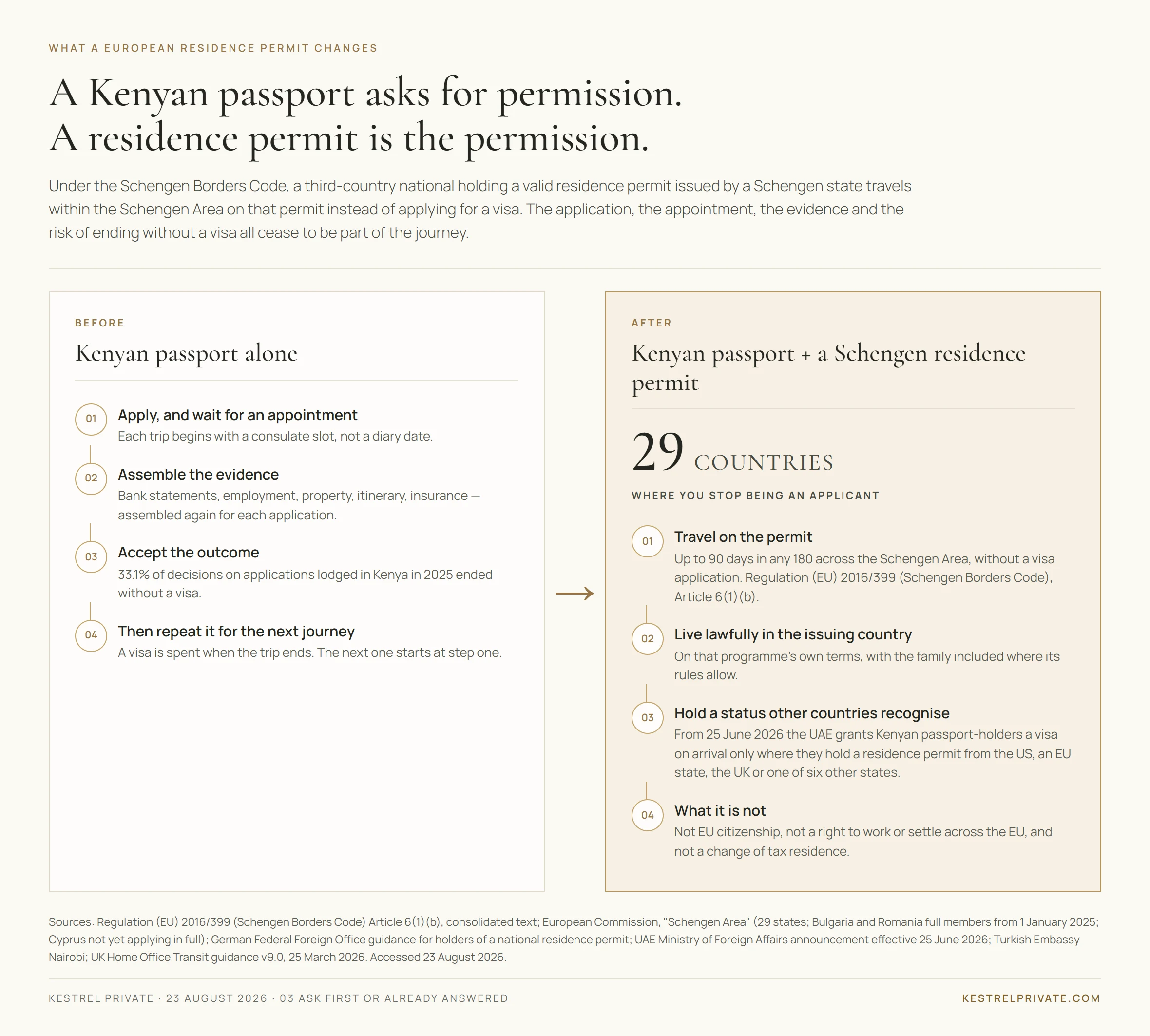
A Kenyan passport normally requires a visa for short visits to the Schengen Area.
A valid residence permit issued by a Schengen country changes that. You can generally travel within Schengen for up to 90 days in any 180-day period without making a separate visa application each time.
You also hold the right to reside in the country that issued the permit, subject to that programme’s conditions.
The distinction matters: the passport remains Kenyan, but your family’s legal position has changed.
Plan A stays. Plan B sits quietly alongside it.
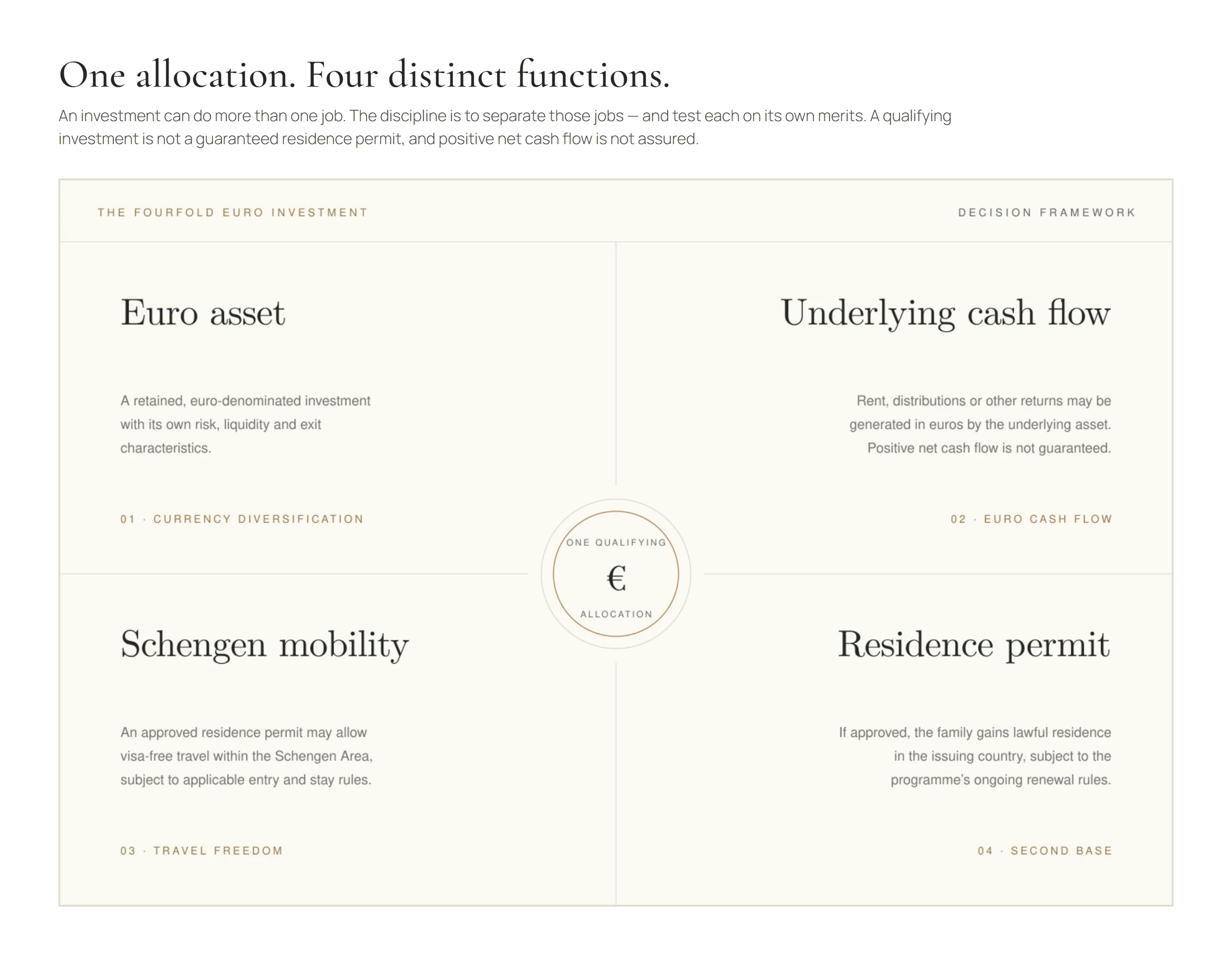
For most of the families we act for this is not an emigration decision. The business, the home and the life stay in Kenya. It is an allocation decision: they are already weighing how much of the family’s capital to hold offshore, in which currency and through which assets, and the question we are asked is whether a defined part of that allocation can also secure something a portfolio on its own cannot — a lawful right for the family to live in Europe.
The same allocation is asked to do four things at once: hold value in euro rather than in shillings, produce potential income or growth in euro, support a European residence position for the family, and — where the programme provides it — widen how freely they travel. One allocation, four functions; but four separate tests, each met on its own merits.
Start with what you want to achieve.
There is no single “best” programme. The right structure depends on the outcome you want.
- European mobility: Greece
- A permanent European base: Cyprus
- A second citizenship: Grenada or São Tomé & Príncipe
We normally decide the objective first and then compare the routes that can achieve it, including the total cost, family eligibility, investment, time required and material limitations. Every route is subject to government due diligence and approval; none of them is granted by making an investment.
Greece
A five-year renewable EU residence permit through qualifying property, subject to government due diligence and approval, with no minimum-stay requirement to maintain it. Short-stay travel across the Schengen Area is then made on the permit, up to 90 days in any 180, rather than on a fresh application each time.
- Property → renewable EU residence
- Schengen travel on the permit — no more visa applications
- A euro-denominated asset, diversifying away from the shilling
- Local EUR banking access, tied to the residence
- No minimum stay to maintain it
€280,000
Cyprus
Permanent residence in Cyprus for eligible family members, subject to approval — an EU jurisdiction with a familiar common-law tradition and English widely used in business and professional life. Cyprus is an EU member but not in the Schengen Area. Accession is EU-backed and expected, but it needs a unanimous Council vote, has no confirmed date and cannot be guaranteed. Its case is a permanent base in Cyprus, not Schengen travel.
- Property → permanent residence
- Whole family, one application
- Common law, in English
Citizenship and residence solve different problems.
Grenada may be relevant where additional international travel access is important. São Tomé & Príncipe provides a substantially lower-cost route to a second citizenship, but its passport should not be considered an upgrade to a Kenyan passport for travel.
For some families, the appropriate structure is therefore European residence for mobility and a separate citizenship for long-term diversification. They do not necessarily need to be acquired at the same time.
Grenada
Citizenship through a government contribution, subject to due diligence and approval. There is no residence requirement under the Act in force, though a presence obligation has passed both Houses and its commencement was deferred by IMA Circular No. 2 of 2026. It reaches the United Kingdom on an electronic travel authorisation and China for short stays. Its Schengen waiver is under EU challenge, set out below.
- Contribution → citizenship
- United Kingdom on an ETA
- No residence requirement under the current Act
USD 255,000
São Tomé & Príncipe
A statute-based citizenship at the lowest current entry cost of the routes on this page, held by most families alongside a European residence rather than in place of one — its own passport is narrower than Kenya’s for travel and is not a mobility upgrade.
- Contribution → citizenship
- Statute-based · Decreto-Lei 07/2025
- Held alongside an EU residence
€100,000
How we calculate the all-in figures
All-in figures are indicative for a single applicant — the qualifying property or contribution plus all taxes, duties, legal, government and due-diligence fees and the €10,000 Kestrel engagement fee — confirmed precisely on engagement. Greece is the €250,000 change-of-use entry tier (Law 5100/2024 art. 64), costed all-in — the tier on which we transact; standard qualifying property is €400,000. On that tier the change of use must be completed before the application is filed, which the law evidences by an engineer’s certificate on the planning act rather than by the building being finished or connected to services, and the category may be used only once per property. Cyprus is the €300,000-plus-VAT qualifying new-build purchase modelled complete at the 19% VAT rate. Grenada is the National Transformation Fund donation (USD 235,000) plus government, due-diligence and processing fees. São Tomé & Príncipe is the complete citizenship stage built on the USD 90,000 single-applicant contribution — about €78,000 — (USD 95,000, about €83,000, for a family of up to four) plus application, due-diligence and professional fees. A qualifying investment does not guarantee approval. Figures verified against the programme dossiers, 2026.
The limits, before the decision rather than after it.
- A residence permit is not citizenship. It authorises residence in the issuing country and short-stay travel within Schengen — not an unrestricted right to work or settle across the European Union, and not a change of tax residence.
- Grenada’s Schengen access is under EU challenge and should be treated as at material risk across the 2026–2028 window; its United Kingdom and China access is unaffected by that process.
- Cyprus is not in the Schengen Area. Cyprus is an EU member but not in the Schengen Area. Accession is EU-backed and expected, but it needs a unanimous Council vote, has no confirmed date and cannot be guaranteed. It is a permanent EU base, not a Schengen route.
- A second passport is not automatically a stronger one. São Tomé & Príncipe is narrower than the Kenyan passport for travel; it is worth holding as a citizenship, not as a travel document.
Full programme conditions and sources
Under Regulation (EU) 2025/2441, operating an investor-citizenship programme is itself a ground for suspending a visa exemption. The European Commission is reported to have written to the five Caribbean programmes on 25 June 2026 seeking a phase-out by 1 June 2028; we have not seen the letters themselves, and no suspension has been enacted. A family acquiring Caribbean citizenship primarily for Schengen access should treat that benefit as at material risk across the 2026–2028 window.
Residence planning as part of a wider family strategy.
For families with children studying internationally — around 15,500 Kenyan students were in tertiary education abroad in 2023, mostly in Australia, the United States and the United Kingdom, per UNESCO — residence planning can form part of a wider family strategy.
Depending on the programme, spouses and children may be included in the same application. Residence may also provide the family with a long-term base in Europe while children are studying abroad.
Eligibility ages, education rights, employment rights and university fee treatment differ materially between programmes, so these are assessed against the family’s circumstances before a jurisdiction is recommended.
Kenya, answered.
- Why are so many Schengen visa applications lodged in Kenya refused?
- The European Commission publishes the outcome, not the reasoning. What its 2025 consulate statistics show is the scale: of 77,760 applications lodged in Kenya, 25,227 were not issued — 33.1%, against 14.6% worldwide. The published data is by consulate location rather than nationality, and individual consulates differ widely: on the same 2025 data, refusal rates in Nairobi ranged from under 17% to over 60% depending on which member state was asked. A valid residence permit issued by a Schengen state usually removes the need for a separate Schengen visa for short stays, subject to the Schengen Borders Code and the ordinary entry conditions, so the journey is made on the permit rather than on an application.
- Does a Greek residence permit let me travel in Europe without a visa?
- Within the Schengen Area, yes — the Schengen Borders Code (Regulation (EU) 2016/399, Article 6(1)(b)) allows a third-country national holding a valid residence permit issued by a Schengen state to travel for up to 90 days in any 180-day period without a visa. The permit also authorises residence in Greece itself on that programme’s terms. It is not EU citizenship and does not confer a right to work or settle across the European Union.
- Would a European permit help with a United Kingdom or United States visa?
- No. The United Kingdom and the United States run their own regimes, and a European residence permit is not a factor in either. It can matter elsewhere: from 25 June 2026 the United Arab Emirates grants a Kenyan passport holder a visa on arrival only where they hold a residence permit issued by the United States, an EU member state, the United Kingdom or one of six other states. Where United Kingdom short-stay access is the objective, Grenadian citizenship may be the relevant instrument to examine — subject to government due diligence and approval, passport issuance, the ETA rules and future United Kingdom policy.
- Can my spouse and children be included?
- Usually, but the eligible relationships, dependant ages and evidence differ by programme, and dependants who qualify at application may age out before renewal. Family composition is tested before the jurisdiction is chosen, not after.
- Which route fits travel, and which fits having a base?
- If the objective is European travel without repeated applications, the Greek residence permit answers it directly. If the objective is United Kingdom short-stay access, Grenadian citizenship may be relevant — subject to approval, passport issuance and the ETA rules. It does not open the United States or Canada, and its Schengen waiver carries the separate EU risk described on this page. If it is a permanent family base in an EU jurisdiction with a common-law tradition and English widely used in business, Cyprus — noting that Cyprus is an EU member but not in the Schengen Area. Most families we act for end up holding a European residence and a second citizenship for different jobs, not one instrument for both.
- Does this mean leaving Kenya?
- No, and most of our clients do not. A residence permit creates the option to spend time in another country lawfully; it carries no obligation to use it, and the Greek route has no minimum-stay requirement to maintain it. The decision being made here is optionality, taken while it can be taken calmly.
Find out which route fits your family.
Tell us who needs to be included, what you currently hold and what you want to achieve. We will compare the relevant routes, confirm the full cost and explain the likely timetable before you make a decision.
If we do not think there is a compelling reason for you to proceed, we will tell you.
Start private assessmentGeneral information only, not legal, tax, immigration or investment advice. Programme rules, processing times, eligible family relationships, visa policies and costs can change. Approval, timing, asset performance and positive net cash flow are not guaranteed. Regulated advice is provided by licensed professionals in the relevant jurisdiction. Kestrel Private manages the private-client engagement and facilitates submission through the required official licensed channels with admitted local professionals. It is not a law firm.
The programme you apply under is the one that exists on the day you file.
For residence applications, we generally plan on approximately two to three months to approval and three to six months from instruction to residence card.
Citizenship applications vary more widely. A straightforward application may receive approval within approximately three months, but six to nine months to passport issuance is a more prudent planning assumption.
Programme rules, government fees and processing times can change. We therefore reconfirm the applicable terms immediately before an application is filed.
Neither approval nor timing can be guaranteed.
If this is the position you want, we can start your file.
A first conversation, not a commitment. Tell us who would be included, what you already hold and what you want the structure to achieve, and we come back with the route, the confirmed terms and the timeline — or tell you if we do not think it is worth proceeding.